
.wp-toc-container {
background-color: #f9f9f9;
border: 1px solid #e2e8f0;
border-radius: 12px;
padding: 25px;
max-width: 600px;
margin: 20px 0;
font-family: -apple-system, BlinkMacSystemFont, “Segoe UI”, Roboto, Helvetica, Arial, sans-serif;
box-shadow: 0 4px 6px rgba(0, 0, 0, 0.05);
}
- 1. 1.What Exactly are Dog Morning Zoomies? (The Science of FRAPs)
- 2. 2.Why Do Dogs Get Zoomies After Waking Up? The Physiological Triggers
- 3. 3.Managing High Energy After Dog Naps: Survival Tips for Owners
- 4. 4.Morning Zoomies vs. Anxiety: Knowing When to Be Concerned
- 5. 5.FAQ: Common Morning Zoomie Questions Over Coffee
- 6. 6.Conclusion: Embracing the Joy of the Zoomie
- 7. Key Terminology & References
.wp-toc-title {
font-size: 1.25rem;
font-weight: 700;
color: #1a202c;
margin-bottom: 15px;
display: flex;
align-items: center;
border-bottom: 2px solid #edf2f7;
padding-bottom: 10px;
}
.wp-toc-title::before {
content: “📋”;
margin-right: 10px;
}
.wp-toc-list {
list-style: none;
padding: 0;
margin: 0;
}
.wp-toc-item {
margin-bottom: 10px;
}
.wp-toc-link {
text-decoration: none;
color: #2d3748;
font-size: 1rem;
display: block;
transition: all 0.2s ease;
padding: 5px 10px;
border-radius: 6px;
}
.wp-toc-link:hover {
color: #3182ce;
background-color: #ebf8ff;
padding-left: 15px;
}
.wp-toc-number {
font-weight: 600;
color: #a0aec0;
margin-right: 8px;
}
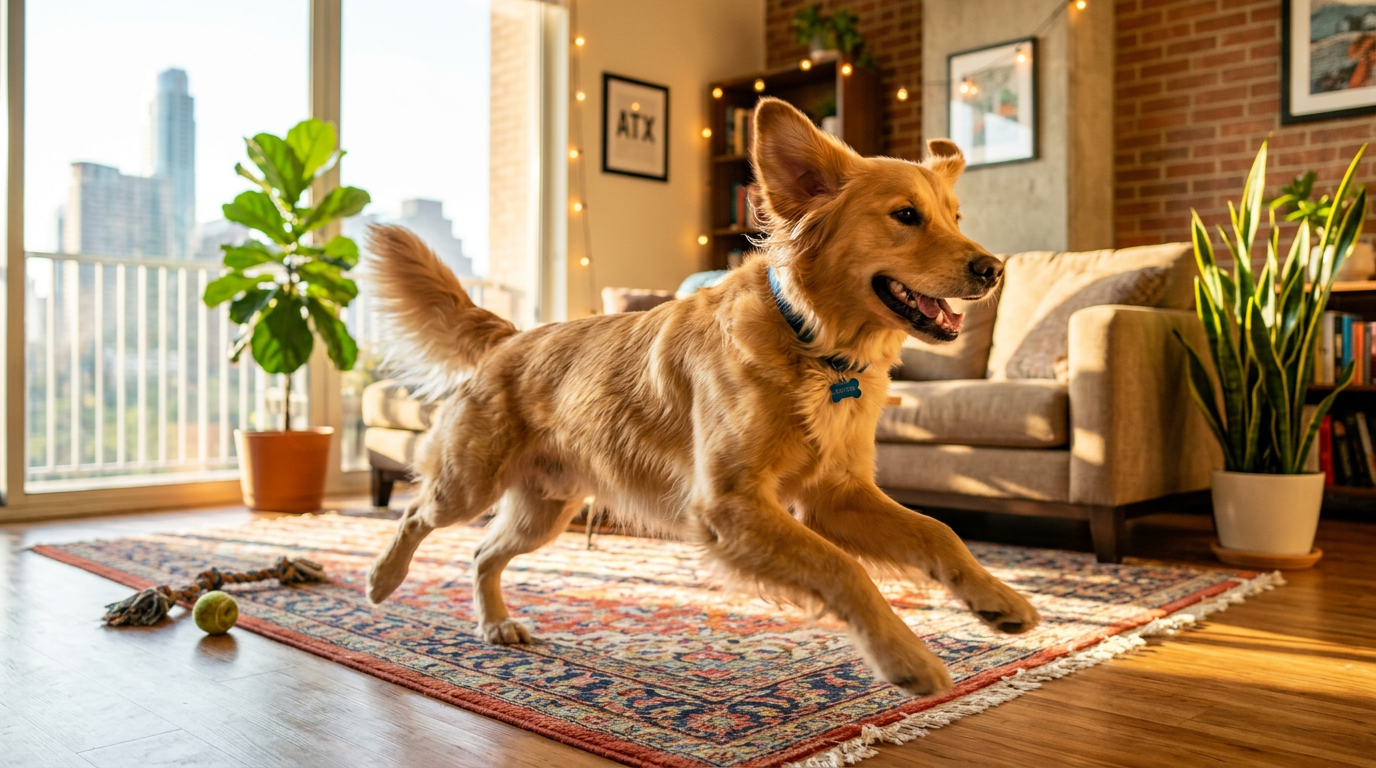
You’ve just taken that first heavenly sip of coffee, but your dog is already turning your living room into a high-speed NASCAR track. It’s that classic burst of dog morning zoomies that leaves us half-awake pet parents wondering if our furry friends found a hidden caffeine stash during their nap.
Honestly, my Golden, Biscuit, does this so often I’ve considered getting him a racing sponsorship! Back when I worked at the clinic, I saw so many owners worry their pup had suddenly “glitched,” but it’s usually just a beautiful explosion of pent-up joy.
In this guide, we’ll dive into the science behind these post-nap sprints and how to tell when the chaos is actually a cry for more exercise. By the end of this, you’ll know exactly how to manage that wild energy safely without sacrificing your morning peace. Trust me, your shins—and your rugs—will thank you for reading this one!
1.What Exactly are Dog Morning Zoomies? (The Science of FRAPs)
You know the feeling. You’ve just opened your eyes, thinking about that first cup of coffee, when suddenly—whoosh! Your dog is off like a rocket. They aren’t just running; they are drifting around the sofa, tail tucked, eyes wide, and tongue flapping in the wind. In the veterinary world, we have a fancy name for these dog morning zoomies. We call them FRAPs.
But don’t let the technical name scare you. Honestly, when Biscuit first started his 7 a.m. “laps” around our living room, I wondered if he’d found a way into Mango’s catnip stash! It turns out, there is some pretty cool science behind why our pups turn into tiny tornadoes the moment they wake up. Understanding the logic behind dog morning zoomies helps you realize that your dog isn’t “broken”—they’re actually feeling fantastic.
Defining FRAPs: Your Dog’s Internal Pressure Valve
First, let’s break down the “official” term. FRAPs stands for Frenetic Random Activity Periods. That sounds like a lot of syllables for something so simple!
What it is: FRAPs are short, intense bursts of energy that dogs just can’t seem to contain.
The Analogy: Think of your dog like a giant bottle of soda. When they sleep, it’s like someone is shaking that bottle up. When they wake up and see you, it’s like popping the cap off. All that fizzy energy has to go somewhere, or the bottle might burst!
What this means for you: When you see the dog morning zoomies in action, it’s basically your dog’s way of releasing a “pressure valve” of built-up excitement.
The “High-Speed Battery Charger” Effect
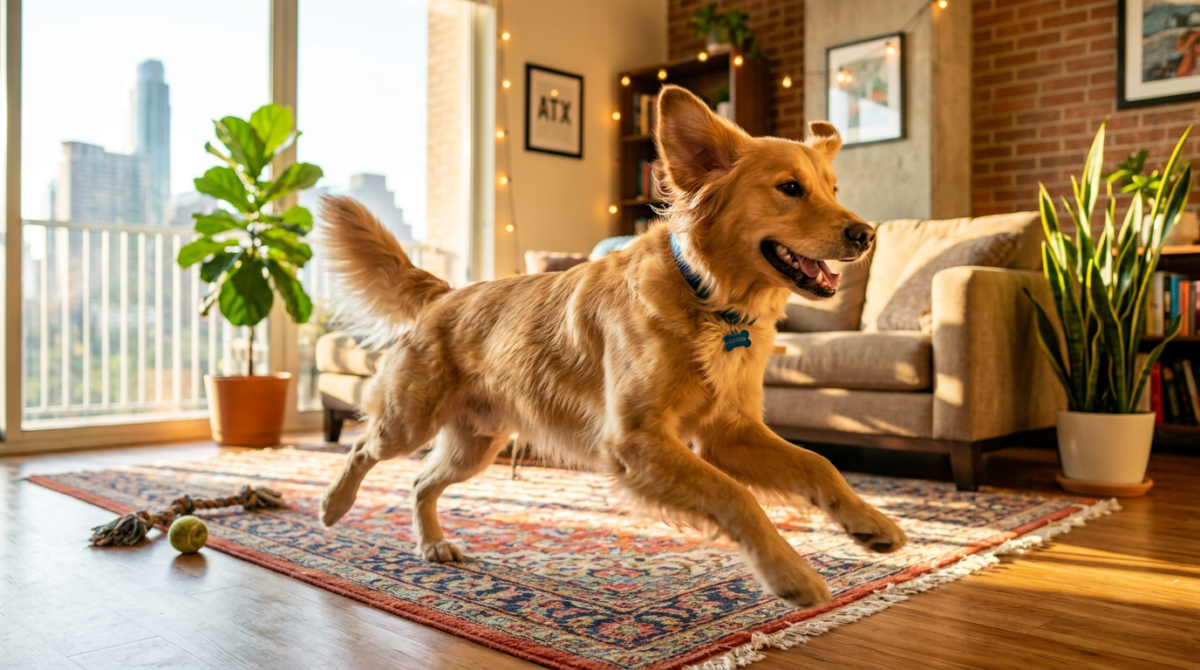
Why do these sprints happen so often right after a nap? It’s because napping acts like a high-speed battery charger for your pup. While they are dreaming about chasing squirrels at Barton Creek, their bodies are actually storing up physical fuel.
Veterinary consensus shows that during deep sleep, a dog’s nervous system is essentially “reloading.” For many pups, the transition from “sleep mode” to “active mode” isn’t a slow crawl—it’s an instant jump to 100%. This sudden surge of power is what triggers the dog morning zoomies. It’s their way of waking up their muscles and getting their blood pumping after being still for so long.
《Dog Behavior Meaning: The Ultimate Guide to Decoding Canine Language》
Case Study: Biscuit’s 7 AM “Living Room Racetrack”
Let me tell you about Biscuit’s ritual. Every single morning, the second I say the word “breakfast,” the dog morning zoomies begin. He doesn’t just run to the kitchen; he takes a detour over the ottoman, under the coffee table, and does a literal 360-turn on the rug.
Back when I was a veterinary assistant, I’d hear from owners who were worried this meant their dog was hyperactive. But here’s the thing: Biscuit is actually a very chill dog the rest of the day. His dog morning zoomies are just a 2-minute “celebration” of being awake. It’s a sign of a healthy, happy nervous system. If your dog is doing this, it usually means they feel safe and excited in their environment.
How to Observe the Zoomies Safely
While the dog morning zoomies are hilarious to watch, they can be a bit hazardous if you have hardwood floors or expensive vases nearby. You want to make sure your pup doesn’t turn their joy into a trip to the vet!
Check the “Traction”: If you have slippery floors, try to guide the dog morning zoomies toward a rug or a carpeted area. Dogs can easily pull a muscle if they slide out of control.
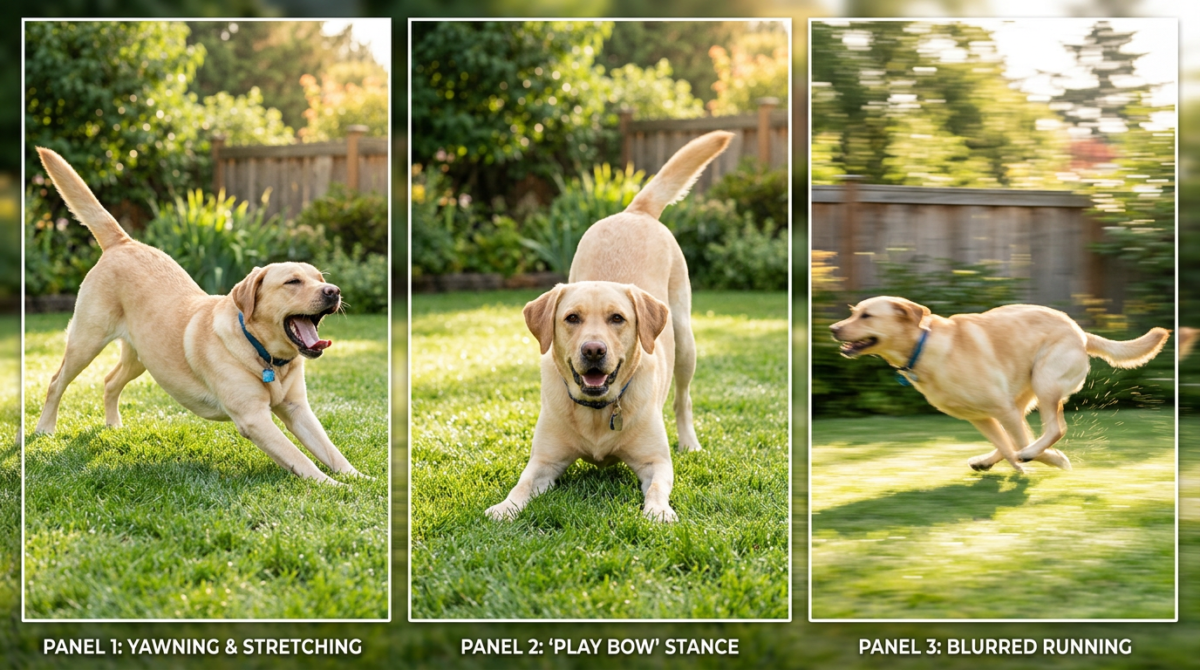
Watch the “Play Bow”: A true zoomie almost always starts with a “play bow”—front legs down, butt in the air. This is your dog’s way of saying, “This is all for fun!”
Clear the Runway: Make sure there are no sharp corners or breakables in their usual “racetrack” path.
Honestly, I’ve learned to just stand back and enjoy the show. Trying to stop dog morning zoomies is like trying to stop the wind—it’s better to just let it blow through! If you are ever worried that the movement looks stiff or painful rather than joyful, that’s when you should take a closer look.
《Dog Symptom Checker: The Ultimate Emergency Health Checklist》
By understanding the “why” behind the dog morning zoomies, you can stop worrying and start laughing. It’s one of those quirky things that makes being a dog parent in a place like Austin so much fun. Just remember: it’s not chaos; it’s just your dog’s way of saying, “Good morning, let’s live life to the fullest!”
2.Why Do Dogs Get Zoomies After Waking Up? The Physiological Triggers for dog morning zoomies
Have you ever noticed that your dog doesn’t just wake up; they explode into the day? While you’re still squinting at the sunlight and reaching for your phone, your pup is already hitting top speeds. It’s not just excitement because you’re awake—though seeing your face is definitely the highlight of their morning. There’s a whole internal “symphony” of hormones and muscle movements happening that triggers those dog morning zoomies.
Think of your dog’s body like a vintage Mustang sitting in a garage in East Austin. It’s been sitting still all night, the engine is cold, and the fuel is just waiting to be burned. When they wake up, they don’t just turn the key; they floor the accelerator!
The Cortisol Spike: Your Dog’s Natural Espresso Shot
One of the main culprits behind dog morning zoomies is a little thing called cortisol. Now, don’t let that word intimidate you.
What it is: Basically, it’s an alertness hormone that helps the body transition from “sleep mode” to “action mode.”
The Analogy: It’s exactly like your automatic coffee maker. It hizzes and gurgles in the background while you’re asleep, and the moment it’s done, you get that sudden jolt of energy that makes you feel human again.
What this means for you: When your dog wakes up, their brain sends out a natural “espresso shot” of cortisol. For many pups, this chemical surge is so strong that they physically have to run to process it.
Back when I was a veterinary assistant, I remember a sweet Greyhound named Lulu. Her owner was convinced Lulu had a “neurological glitch” because she would spin in circles every morning at 6 a.m. sharp. We ran some tests and found she was perfectly healthy—her body was just producing a very enthusiastic morning cortisol spike. She wasn’t glitching; she was just “fully charged” and ready for the dog morning zoomies.
Shaking Off the Sleep “Rust”
Beyond hormones, there’s a mechanical reason for dog morning zoomies. When a dog sleeps, their muscles relax and their heart rate slows down significantly—sometimes dropping as low as 60 beats per minute. This is their body’s way of deep-cleaning and repairing itself.
However, waking up requires a rapid “re-boot.” This involves something we call “Pandiculation”—which is just a fancy way of saying that deep, soul-satisfying stretch dogs do. But sometimes, a stretch isn’t enough to get the blood flowing to those big leg muscles. That’s when the dog morning zoomies kick in. By sprinting, they are rapidly increasing their heart rate and “flushing” their muscles with fresh, oxygen-rich blood. It’s the ultimate full-body wake-up call.
《Dog Symptom Checker: The Ultimate Emergency Health Checklist》
The “Morning Potty” Connection
We can’t talk about dog morning zoomies without mentioning the most practical trigger: the full bladder. Think about how you feel when you wake up and really have to go. You aren’t exactly dawdling to the bathroom, right?
For a dog, that internal pressure adds a layer of physical urgency. Many dogs get the “pre-potty zoomies” or the “post-potty zoomies.” It’s a mix of relief and a sudden realization that they are finally outside in the fresh Austin air. I see this every weekend at the Barton Creek Greenbelt—dogs hopping out of cars and immediately doing laps. It’s a physiological “happy dance” because their body feels light and ready to move.
How to Help Your Dog “Download” Their Energy
If your pup’s dog morning zoomies are a bit too intense for your small apartment, you can actually help them process this physiological rush more efficiently. Honestly, I had to do this with Biscuit when we lived in a second-floor walk-up!
The Immediate Potty Break: Don’t wait for your coffee to brew. Getting them outside immediately helps satisfy that physical urge and gives them a safe space for their dog morning zoomies.
Gentle Interaction: Instead of wrestling (which ramps them up further), try a few “calm-down” commands like Sit or Down right after the first lap. It helps their brain catch up to their racing heart.
Check for “Zoomie Triggers”: If your dog always zooms when they hear the kibble bag, try using a slow-feeder. This forces their brain to engage, which can help burn off that cortisol spike without the living room “drift.”
Veterinary consensus shows that a healthy morning “burst” can actually improve a dog’s mood for the entire day. This means for you and your pet, those 60 seconds of chaos are actually a great investment in their mental health. You aren’t a bad owner if you find the dog morning zoomies a bit overwhelming—it took me a year to realize Biscuit wasn’t trying to knock over the TV on purpose!
《Dog Behavior Meaning: The Ultimate Guide to Decoding Canine Language》
Next time you see your dog tearing across the carpet, just remember: it’s not just “crazy” behavior. It’s their internal engine warming up, their hormones saying “hello,” and their heart celebrating a brand new day. It’s the most natural, healthy way to start the morning—even if it means you have to straighten the rugs once or twice!
3.Managing High Energy After Dog Naps: Survival Tips for Owners for dog morning zoomies
Let’s be real: as much as we love seeing our dogs happy, 7 a.m. isn’t exactly the ideal time for a 70-pound Golden Retriever to use the sofa as a launching pad. When dog morning zoomies hit, it can feel like you’re trying to manage a furry hurricane in a gift shop. But here’s the secret—you don’t want to stop the energy; you just want to give it a “lane” to run in.
Think of your dog’s morning burst like a flash flood in a dry Austin creek bed. You can’t stop the water from coming down, but you can build banks to make sure it doesn’t wash away your house!
Creating a “Safe Zoom Zone”
The biggest risk during dog morning zoomies isn’t actually the running; it’s the lack of traction. Back when I worked at the clinic, we saw so many “Zoomie Injuries”—mostly pulled CCLs (that’s the dog version of an ACL tear) because a pup slipped on a hardwood floor while trying to make a sharp turn.
What it is: Environmental management. It’s basically “puppy-proofing” for high speeds.
The Analogy: It’s like putting a non-slip mat in a bathtub. You’re not stopping the bath; you’re just making sure nobody slips and falls.
What this means for you: If your home is mostly tile or wood, your dog is essentially running on ice. Investing in a few well-placed area rugs can literally save you thousands in vet bills.
The 5-Minute “Energy Redirect” Method
When Biscuit starts his “racetrack” routine, I don’t just stand there and yell. Honestly, I used to, and it just made him think I was cheering him on! Instead, I use what I call the Redirect Strategy. The goal is to move the energy from “mindless sprinting” to “purposeful play.”
The “Low-Impact” Toy: Keep a soft, plush toy near your bed. The moment the dog morning zoomies start, toss the toy away from the furniture. This gives them a target and keeps them on the floor.
Outdoor Transit: If you have a yard, make the “Zoom Zone” outside. Open the door and let that 100% battery charge expire on the grass where they have better grip.
The “Scent Walk”: Once the initial 60 seconds of sprinting is over, immediately engage their nose. Scatter five small treats on a rug.
《Dog Behavior Meaning: The Ultimate Guide to Decoding Canine Language》
Is It Too Much? Zoomies vs. Under-Stimulation
Sometimes, dog morning zoomies aren’t just a “happy wake-up”—they’re a sign that your dog is “unemployed.” Dogs are working animals by nature. If they didn’t get enough exercise or mental puzzles yesterday, today’s morning burst will be twice as wild.
I remember a client with a Border Collie named Jax. Jax’s dog morning zoomies were so intense he was actually nipping at the owner’s ankles. It turned out Jax was just bored out of his mind. We started giving him a “puzzle breakfast”—putting his kibble inside a rolling toy—and his morning chaos dropped by 50% within a week.
Check the Intensity: If the zoomies last longer than 5 minutes or involve destructive behavior (chewing the rug, jumping on people), your dog is likely telling you they need more “brain work.”
The “Emily” Pro-Tip: A tired dog is a happy dog, but a mentally tired dog is a calm dog. Try a 10-minute training session right before bed to see if it rounds off the edges of tomorrow’s dog morning zoomies.
The “Austin Morning” Protocol
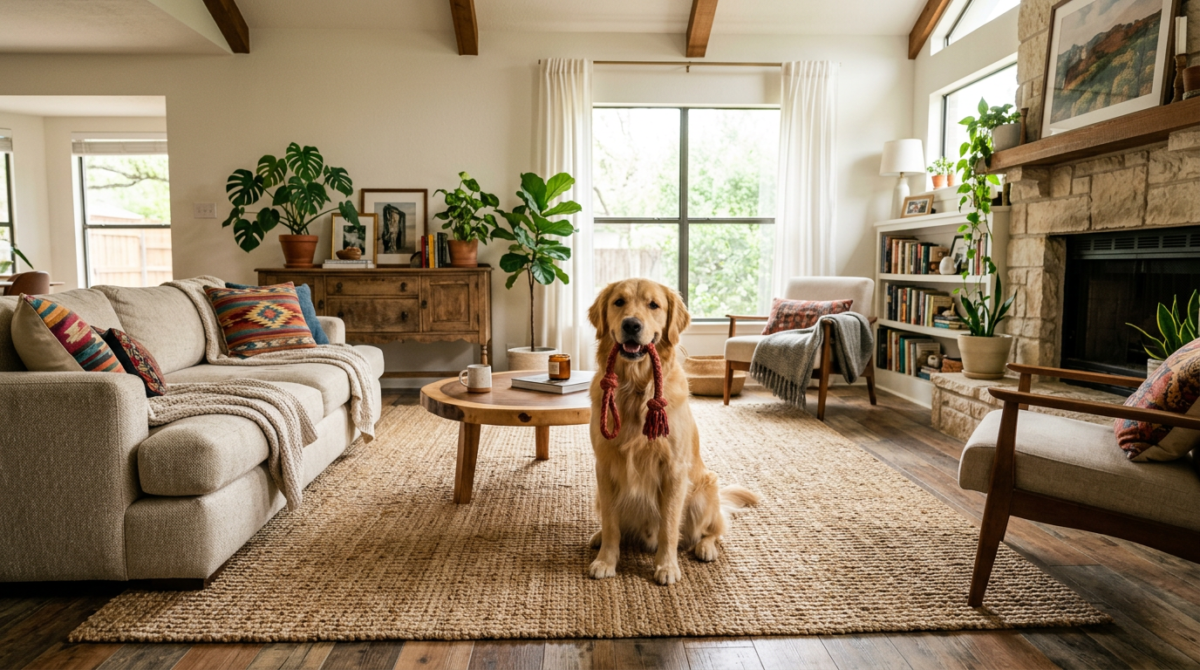
Honestly, I made the mistake of trying to “command” Biscuit to sit in the middle of a zoomie once. It didn’t work, and I almost got knocked over! You have to remember that during dog morning zoomies, their “listening brain” is temporarily offline. It’s like trying to talk to someone who’s wearing noise-canceling headphones at a rock concert.
Instead of fighting it, I’ve learned to just clear the “runway” and wait it out. By the time I’ve finished pouring my creamer, Biscuit is usually panting happily on his rug, ready for a calm morning walk at Zilker Park. You aren’t losing control of your dog; you’re just letting them be a dog for sixty seconds.
《Safe Pain Relief & Medications for Dogs: The Science-Backed Safety Protocol》
4.Morning Zoomies vs. Anxiety: Knowing When to Be Concerned
It’s easy to laugh at a dog doing laps around the coffee table, but sometimes as pet parents, we wonder: Is he actually happy, or is he losing his mind? Distinguishing between joyful dog morning zoomies and a stress-driven breakdown is a skill every owner should have in their back pocket.
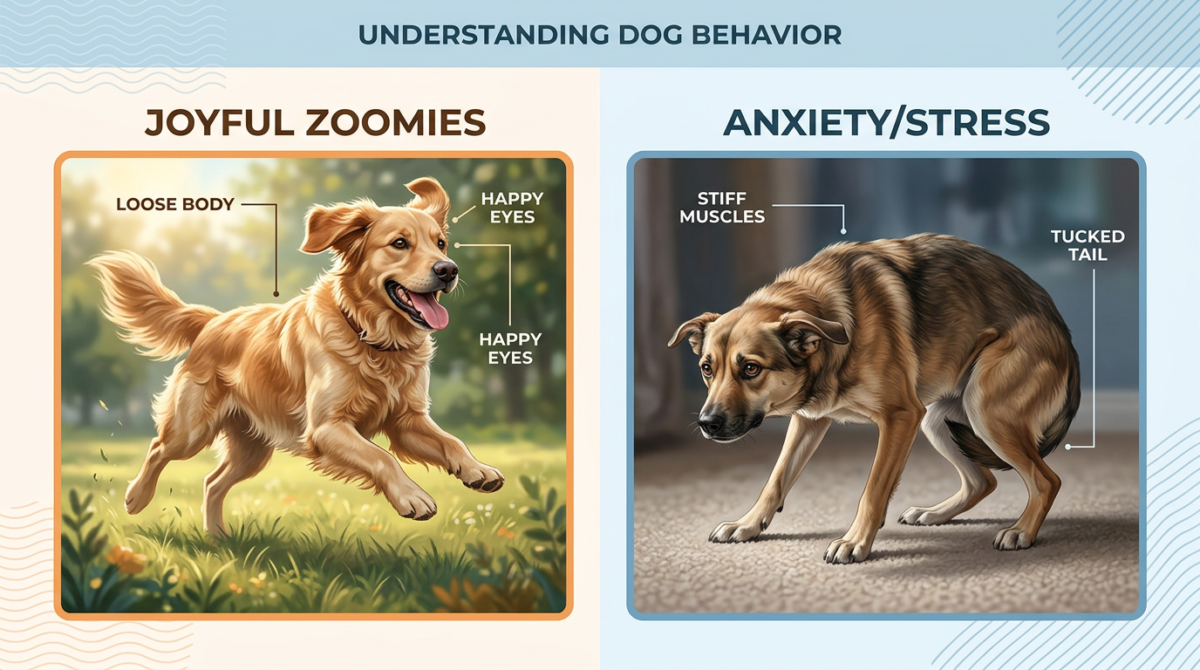
Think of your dog’s energy like music. Happy zoomies are like a high-energy dance track—it’s loud and fast, but everyone is having a great time. Anxiety-driven behavior is more like a scratched CD that keeps skipping on the same loud note. One is a celebration; the other is a “glitch” caused by stress.
Body Language Cues: The “Play Bow” vs. Stiff Movements
The biggest giveaway of healthy dog morning zoomies is how “loose” your dog looks. When Biscuit is in the middle of a morning sprint, his body is curvy, his mouth is open in a “smile,” and he’s constantly looking at me to see if I’m watching.
The Play Bow: This is the international dog sign for “Everything I’m about to do is just a game!” If your dog drops their front elbows to the ground while their butt stays in the air, you’re looking at pure joy.
The “Stiff” Sprint: If your dog is running but their muscles look tight, their tail is tucked tightly between their legs (not just slightly tucked for aerodynamics), and their eyes look dilated or panicked, this isn’t your typical dog morning zoomies. This might be a “flight” response to a sound or a feeling of unease.
The “Obsessive Loop”: When Zoomies Turn into Pacing
In the vet clinic, we sometimes saw dogs with “stereotypical behaviors”—basically repetitive actions that the dog feels they must do, even if they aren’t having fun.
What it is: A compulsive behavior (like tail-chasing or pacing) that looks like a zoomie but lacks the “random” fun.
The Analogy: Imagine the difference between someone dancing at a wedding and someone pacing back and forth in a hospital waiting room. Both involve movement, but the “vibe” is completely different.
What this means for you: If your dog morning zoomies turn into your dog chasing their tail for ten minutes straight or running the exact same circle until they are exhausted and panting heavily but can’t stop, that’s a red flag.
I remember a sweet Aussie named Shadow who would “zoom” every morning, but he would only run in a tight figure-eight. He wouldn’t look at his owners, and he wouldn’t stop for treats. It turned out he had severe separation anxiety, and his “zoomies” were actually a way to cope with the stress of his owners getting ready for work.
《Dog Behavior Meaning: The Ultimate Guide to Decoding Canine Language》
Vet’s Corner: When to Call the Pro
Most dog morning zoomies last between 30 seconds and two minutes. They end with a big sigh, a flop onto the rug, and maybe a long drink of water. However, you should mention your dog’s morning behavior to your Austin vet if you notice these “Emily’s Red Lines”:
The “Trance” State: You can’t get their attention even with a piece of cheese or a squeaky toy.
Self-Injury: They are running into walls or furniture so hard they are bruising themselves.
The Never-Ending Zoomie: The high energy lasts for 15+ minutes and doesn’t seem to have an “off” switch.
Aggression: If the zoomies involve snappy behavior or growling that feels “mean” rather than “playful.”
The “Emily” Comfort Check
Honestly, I made the mistake of over-analyzing Biscuit’s behavior during his first year. I’d sit there with my Texas A&M textbooks trying to diagnose him while he was just trying to show me his favorite toy! You aren’t a bad owner for worrying—it shows you’re paying attention.
If you’re ever in doubt, grab your phone and take a quick 30-second video of the dog morning zoomies. Show it to your vet at your next check-up. They can tell in two seconds if that tail-tuck is just for speed or if it’s a sign of a worried pup. For 99% of us, though, these morning sprints are just a sign that our dogs feel safe, healthy, and absolutely thrilled to start another day in our homes.
《Dog Symptom Checker: The Ultimate Emergency Health Checklist》
Next time you see those “crazy eyes” and the tucked-butt run, take a deep breath. If their body is loose and they’re looking for your reaction, just enjoy the show! You’ve got a happy dog on your hands.
5.FAQ: Common Morning Zoomie Questions Over Coffee
When I’m out at the local coffee shop here in Austin, these are the questions I get most often. It’s totally normal to feel a bit of “parental worry” when your pup is acting like a caffeinated kangaroo! Let’s break down the most common head-scratchers about those dog morning zoomies.
Is it safe for my dog to zoom right after breakfast?
This is a big one, and honestly, it’s something I’m very strict about. In the vet world, we worry about something called Gastric Dilatation-Volvulus, but let’s just call it “Bloat.”
What it is: Basically, it’s when a dog’s stomach fills with gas and flips over on itself like a heavy, wet bag of groceries.
The Analogy: Imagine putting a half-full gallon of milk in the back of a truck and taking a sharp turn at 50 mph. That milk is going to slosh and flip!
What this means for you: If your pup has dog morning zoomies right after a big meal, that full stomach can shift dangerously. I always recommend waiting at least 30 to 60 minutes after eating before letting the wild running begin. Better safe than sorry!
《Dog Symptom Checker: The Ultimate Emergency Health Checklist》
Why does my senior dog still get the zoomies?
I love this question! People often think dog morning zoomies are just for puppies, but that’s a total myth.
Think of it like your grandma hitting the dance floor at a wedding when her favorite song comes on. She might not be as fast as she used to be, and she might feel it in her knees the next day, but the joy is exactly the same! For a senior dog, a morning burst is a sign that they still feel spirited and happy. Just keep an eye on their joints—if they seem stiff afterward, you might want to look into some joint support.
《Safe Pain Relief & Medications for Dogs: The Science-Backed Safety Protocol》
Why do dogs bark or “talk” while they are zooming?
Does your dog let out a high-pitched “woo-woo” or a play-growl while they are sprinting? This is what I call the “Soundtrack of Joy.”
When dogs are in the middle of dog morning zoomies, their vocal cords get in on the action too. It’s part of the play ritual. In the wild, vocalizing helps tell other members of the pack, “Hey, I’m just playing, don’t mind me!” As long as their body is loose and their tail is wagging, that “barking” is just them narrating their own fun. Honestly, Biscuit gets so vocal during his laps that I swear he’s trying to tell me a joke!
【图片建议:dog_barking_while_running.jpg】 【Alt 文案:A happy dog with an open mouth ‘talking’ or barking while mid-sprint during morning zoomies.】 【AI 提示词:Action photography of a vocal dog, mouth open, ears back, happy expression, running through a sun-dappled yard, focus on the facial expression of joy, 85mm, f/1.8.】
6.Conclusion: Embracing the Joy of the Zoomie
At the end of the day—or rather, the beginning of it—the dog morning zoomies are one of those quirks that remind us why we invited these four-legged chaos-makers into our homes in the first place. Whether it’s a release of built-up hormones, a way to shake off the “sleep rust,” or just a celebration of seeing your face, it’s a sign of a dog who feels safe and loved.
I used to worry that Biscuit was going to knock over my favorite Austin-themed coasters or wake up the neighbors, but now I just see it as his morning “gratitude dance.” By creating a safe space and understanding the why behind the speed, you turn a stressful moment into a bonding one.
The “Emily Method” for a Balanced Morning
If you take away nothing else from our chat today, remember this: don’t fight the zoomie, just guide it.
Accept the energy: It’s a physiological “pressure valve” that needs to be released.
Prioritize safety: Rugs are your best friend to prevent vet-visit-worthy slips.
Observe the vibe: If the body is loose and the tail is wagging, you’re all good.
《Dog Behavior Meaning: The Ultimate Guide to Decoding Canine Language》
Your Happy Dog Action List: 3 Things to Do Tomorrow
Ready to make tomorrow morning a little smoother? Try these three steps when you hear those first “zoomie” paws hitting the floor:
Clear the Runway: Take 10 seconds to move any shoes, bags, or fragile items off the floor before you even start the coffee.
Redirect with Purpose: Have a soft toy ready. If your dog gets too “mouthy” or jumpy, toss the toy to give that energy a constructive outlet.
Check for “The After-Zoomie Sigh”: Once they stop, wait for that big deep breath and a stretch. That’s your signal that the energy has “downloaded” and they are ready for a calm, structured morning walk.
Honestly, I still make mistakes—like leaving my slippers in the “impact zone”—but that’s just part of the journey. You’re doing an amazing job just by wanting to understand your dog better. Now, go give your pup a scratch behind the ears (once they’ve stopped running, of course!) and enjoy the ride.
Key Terminology & References
To provide our readers with accurate scientific context, the following professional terms are linked directly to their respective entries in the Wikipedia Encyclopedia.
—————————————-
Veterinary Medicine
Dog Behavior
Dog Breeds
Understanding your dog behavior is key to a happy relationship. Read more about Dog Tail Wagging Decoded: The Science Behind It.
Conclusion
Taking proactive steps to address your dog’s health and behavior concerns is the best way to ensure they live a happy, comfortable life. By staying informed and working closely with your veterinarian when needed, you can provide the care your furry companion deserves. Remember that early intervention often leads to better outcomes and can prevent minor issues from developing into more serious conditions.